All prime numbers are contained in a 1x rectangle. Prime numbers are 2, 3, 5, 7, 11, 13, 17 etc.
Odd numbers cannot be in a 2x rectangle (Example: 9 = 1x9 or 3x3).
Anytime you have a number beside another number, you know that they are contained in different areas, therefore you know that a line goes between them. This is shown with the 3 and 4 in the sample puzzle below.
Friday, May 20, 2011
Saturday, May 14, 2011
COLOR PICTURE MAZE #1 - BEGINNER LEVEL
This might be the one and only Color Picture Maze I make because it takes so much time to draw it on the computer. Start from the upper left corner and work your way through the maze changing colors throughout the maze to match the colored dots given to you. End at the star. The easiest way to work this puzzle is to double click on the picture and save it to your computer. Then open it in paint.
COLOR PICTURE MAZE #1 - BEGINNER LEVEL
Tuesday, May 3, 2011
FILLOMINO #1 - BEGINNER LEVEL
A fun new kind of puzzle for you to enjoy...
Fillomino Rules
Helpful Hint for Fillomino
FILLOMINO #1 - BEGINNER LEVEL

Fillomino Rules
Helpful Hint for Fillomino
FILLOMINO #1 - BEGINNER LEVEL

FILLOMINO HELP
Whenever there are two 2's diagonal to eachother and you know by the rules that they cannot horizontally or vertically share sides, they must be seperated from eachother.
FILLOMINO RULES
Fillomino puzzles are grids that have numbers in them which tell you how to block off the grid into areas. Seperate the grid by drawing thick lines to block off cells. Every square in the grid must be used and cells with numbers tell you how many cells are contained in the blocked off area that contain it. Not all blocked off areas contain a number. No areas with the same number of cells can be vertically or horizontally adjacent to eachother (in other words, no area of 4 can share an edge with another area of 4).
Small Sample Puzzle:
Monday, April 25, 2011
HANJIE #1 - BEGINNER LEVEL
Hanjie otherwise known as nonograms show a very simplistic idea of a pencil puzzle. The rules are very simple and easy, but the execution of these rules can get to be very complicated in more complex puzzles.
Rules: You have a grid of squares, which must be filled in with a specific pattern as given to you by the numbers on the sides of the grid. These numbers are listing the lengths of the runs of filled in squares on that row or column in the order that it shows on the grid. (Example: the numbers beside a row are listed as 1 4 2; the 1 filled square will be to the left of the run of 4 filled in squares, and the run of 4 filled squares is to the left of the 2 filled squares) All runs of filled in squares must be seperated by atleast 1 blank square. The end result is usually a picture.
Sample of finished puzzle:
Nonograms can look confusing and be frustrating if you aren't sure where to begin. I always look at all the rows one by one and then move to the columns. I have provided some basic help on the "Pencil Puzzle Help" page to start you off. The "Pencil Puzzle Help" page is located in the left column of the blog. Use dots to indicate a square that will not be filled in.
HANJIE #1 - BEGINNER LEVEL
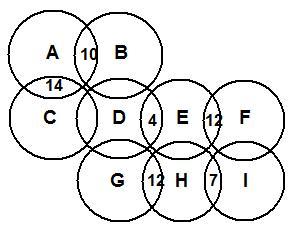
SHAPE KAKURO #1 - BEGINNER LEVEL
In this Shape Kakauro puzzle each shape has a letter in it. Each letter has a different number value (1 through 9). Where the shapes overlap there is a number that equals the sum of the values in those shapes. Find the value of each letter in the puzzle.
SHAPE KAKURO #1 - BEGINNER LEVEL
SHIKAKU #2 - INTERMEDIATE LEVEL
SHIKAKU RULES
On the Pencil Puzzle help page you would find this helpful hint...
All prime numbers are contained in a 1x rectangle. Prime numbers are 2, 3, 5, 7, 11, 13, 17 etc.
Odd numbers cannot be in a 2x rectangle (Example: 9 = 1x9 or 3x3)
SHIKAKU #2 - INTERMEDIATE LEVEL
On the Pencil Puzzle help page you would find this helpful hint...
All prime numbers are contained in a 1x rectangle. Prime numbers are 2, 3, 5, 7, 11, 13, 17 etc.
Odd numbers cannot be in a 2x rectangle (Example: 9 = 1x9 or 3x3)
SHIKAKU #2 - INTERMEDIATE LEVEL
Tuesday, April 19, 2011
SHIKAKU RULES
SHIKAKU RULES ~
Divide the grid up into rectangles. Numbers within the grid give you the AREA of the rectangle to be drawn around it. Each rectangle has a number in it and every square in the grid will be used. Rectangles cannot overlap. AREA = LENGTH x WIDTH (Example: the number 12 can be contained in a 1x12, 2x6, or 3x4 rectangle)
Small example of finished puzzle:
Sunday, April 17, 2011
HEX TAKEGAKI #1 - INTERMEDIATE LEVEL
Hex Takegaki has a familiarity to regular Takegaki. Read the rules for solving here and get to looptie-looping.
If you need help on how to solve a Hex Takegaki puzzle click this link - HELP!!
HEX TAKEGAKI #1 - INTERMEDIATE LEVEL
If you need help on how to solve a Hex Takegaki puzzle click this link - HELP!!
HEX TAKEGAKI #1 - INTERMEDIATE LEVEL
HEX TAKEGAKI HELP
HEX TAKEGAKI HELP~
Note: The following pictures are used as a visual guide and are not full puzzles.
Figure A: We know that there are no acute angles in the loop, only obtuse angles are used.
Figure B: I always find it helpful to shade in the areas that I know will not be a part of the loop.
Figure C: Any time there is a "1" on a side of a puzzle you know that the hexagons beside it on the side are not a part of the loop.
Figure D. Anytime there is a "3" in a corner of the puzzle it looks like this.
Figure E. If there is a "4", "5", or "6" in the hexagon directly adjacent to the corner, you know that the loop must go through the three hexagons around the corner.
HEX TAKEGAKI RULES
HEX TAKEGAKI RULES ~
Hex Takegaki has the same rules as regular Takegaki except that there are six sides to every shape instead of four. The objective is to connect adjacent hexagons so that the lines form a single loop with no loose ends. The loop cannot cross itself. In addition, the number inside a hexagon represents how many of its six adjacent hexagons have segments in the loop. Hexagons with numbers in them cannot be part of the loop and the loop never takes an acute angle turn.
Small Sample of Finished Puzzle-
TAKEGAKI RULES
TAKEGAKI RULES ~The objective is to connect horizontally and vertically adjacent dots so that the lines form a single loop with no loose ends. The loop cannot cross itself. In addition, the number inside a square represents how many of its four sides are segments in the loop. Squares without numbers in them can still have segment sides.
Friday, April 8, 2011
Welcome to The Use of Labels
Princess Pencil Puzzle welcomes the use of labels on her blog. Labels are basically links that will put all of one type of blog into a database. Therefore when you come to my blog wanting Takegaki puzzles, all you have to do is click the "Takegaki" label on the left column of the blog. This will bring up ALL Takegaki puzzles that I have on the blog and rules and maybe even a Takegaki help page.
All of my blogs that are puzzles have been labeled and can be found in the left column of the blog. You can also follow the label by clicking the link below the blog. For instance, if you are looking at a Zig-Zag puzzle, then there is a link below the blog entry that says "Zig-Zag" for you to find more Zig-Zag puzzles and information.
Good Luck and Happy Puzzling,
Princess Pencil Puzzle
Thursday, April 7, 2011
Saturday, March 26, 2011
ZIG-ZAG RULES
ZIG-ZAG RULES ~
Starting with the "1" at the top left corner of the grid, find the path that goes through every number on the grid to the bottom right number. The path does not cross itself and only goes in numerical order (1, 2, 3, 4, 1, 2, 3, 4, 1 etc.). The path can move horizontally, vertically, and diagonally.
Tuesday, March 22, 2011
Excited to Be Worldwide on The World Wide Web
I look at the audience of people that have found my awesome blog on the "stats" page for blogger.com. It is so great that people from all over the world have been checking out my blog! People have found me by using google.uk (United Kingdom), google.au (Australia), google.hu (Hungary), and google.nl (Netherlands) to name a few. And of course all my FB friends that got to my blog through links on Facebook. I just find it so interesting to see that people from countries like Venezuela, Spain, Brazil, and Sweden and many more have taken an interest in my blog. The power of the World Wide Web is magnanimous!
Please post the country you live in as a comment below...
Sunday, March 20, 2011
TAKEGAKI #2 - INTERMEDIATE LEVEL
Takegaki rules can be found here - PENCIL PUZZLE RULES
and helpful hints can be found here - PENCIL PUZZLE HELP
TAKEGAKI #2 - INTERMEDIATE LEVEL
and helpful hints can be found here - PENCIL PUZZLE HELP
TAKEGAKI #2 - INTERMEDIATE LEVEL
Friday, March 11, 2011
HANJIE #2 - BEGINNER LEVEL
Hanjie otherwise known as nonograms show a very simplistic idea of a pencil puzzle. The rules are very simple and easy, but the execution of these rules can get to be very complicated in more complex puzzles.
Rules: You have a grid of squares, which must be filled in with a specific pattern as given to you by the numbers on the sides of the grid. These numbers are listing the lengths of the runs of filled in squares on that row or column in the order that it shows on the grid. (Example: the numbers beside a row are listed as 1 4 2; the 1 filled square will be to the left of the run of 4 filled in squares, and the run of 4 filled squares is to the left of the 2 filled squares) All runs of filled in squares must be seperated by atleast 1 blank square. The end result is usually a picture.
Sample of finished puzzle:
Nonograms can look confusing and be frustrating if you aren't sure where to begin. I always look at all the rows one by one and then move to the columns. I have provided some basic help on the "Pencil Puzzle Help" page to start you off. The "Pencil Puzzle Help" page is located in the left column of the blog. Use dots to indicate a square that will not be filled in.
For hanjie #2 you might want to use the color GREEN to fill in the squares...
HANJIE #2 - BEGINNER LEVEL
Subscribe to:
Posts (Atom)